Oops! Something went wrong while submitting the form.
By providing a telephone number and submitting this form you are consenting to be contacted by SMS text message. Message & data rates may apply. You can reply STOP to opt-out of further messaging.
AI Tools
Boost Your Human Productivity with AI
AI doesn't replace your team's judgment — it eliminates the repetitive work that buries it.
Praveen Ghanta, CEO, Hire Fraction·July 16, 2024·8 min read
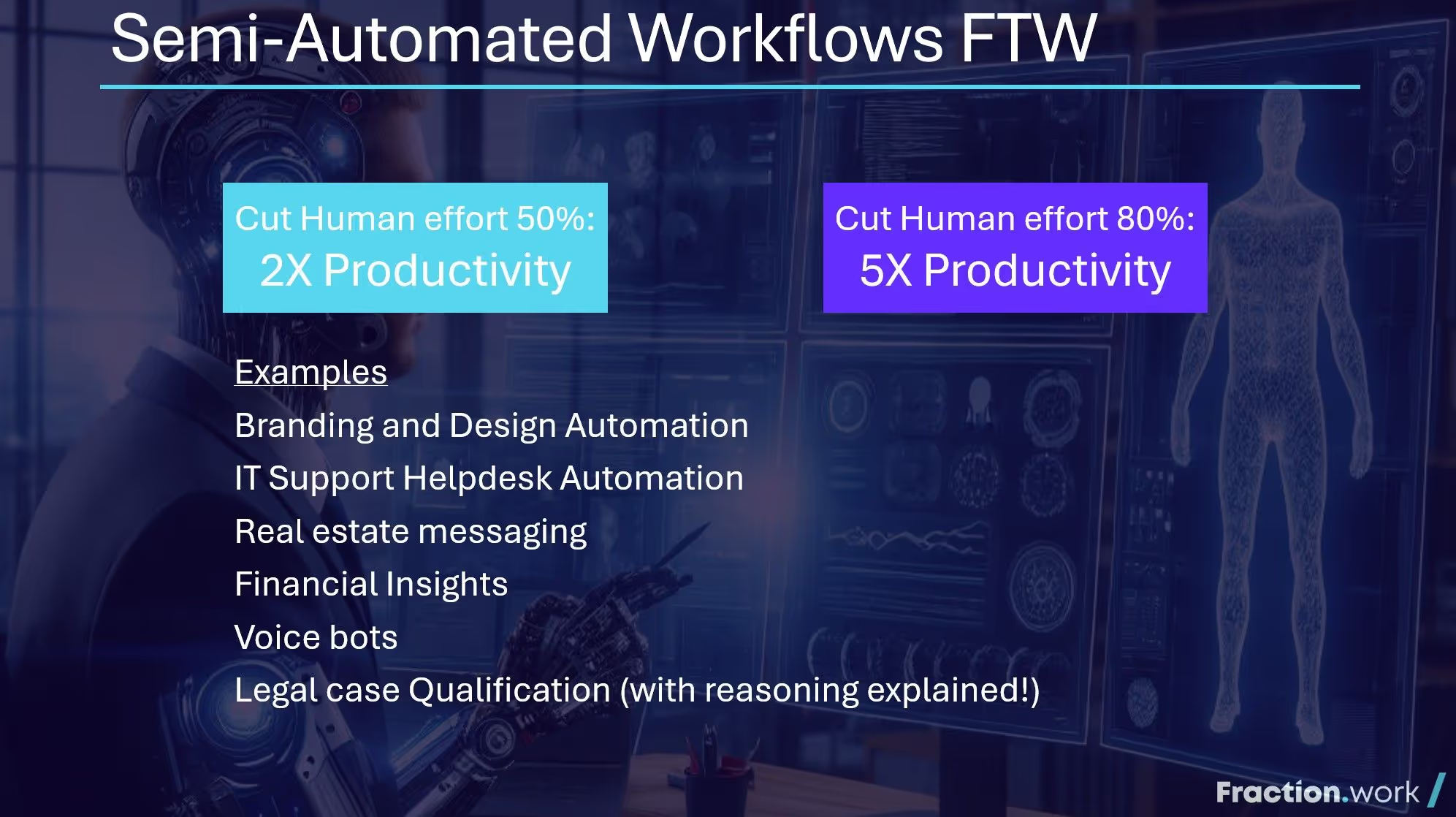
The exact two-phase target Fraction uses: 50% workload reduction first, then the push to 80%
Why diagramming your workflow before choosing any AI tool is the step most teams skip — and why it costs them
Which task types are the fastest to automate and which require a human-in-the-loop by design
How to define KPIs before automation starts so you can actually prove ROI afterward
Real-world automation patterns across design, IT helpdesk, fintech, and legal case management
Many professionals face overwhelming workloads and tight deadlines that result in burnout and declining output quality. AI-driven workflow automation offers a practical way out — not by replacing human judgment, but by handling the repetitive work that consumes the time you need for the decisions that actually matter.
What is workflow automation and why does it matter now?
Definition
Workflow automation: the use of technology — including AI agents and LLM-based systems — to handle repetitive, rule-bound tasks without manual intervention, freeing human workers to focus on higher-value activities that require judgment, creativity, or relationship management.
Workflow automation is not new, but AI has changed what is automatable. Tasks that previously required scripted rules and structured data — writing first drafts, categorizing tickets, summarizing documents, flagging anomalies — can now be handled by models that understand context. The practical implication is that the ceiling on what a small team can automate has risen sharply in the last two years.
Fraction’s experience across dozens of engagements shows that breaking down a workflow and targeting 50% automation first delivers measurable gains quickly, builds team confidence, and creates a foundation for the next phase. Organizations that aim for 100% automation from day one almost always stall.
How does AI augment human productivity rather than replace workers?
The most effective AI implementations treat the technology as a force multiplier for human workers, not a replacement. AI should handle the parts of a job that are repetitive, well-defined, and data-rich. Humans retain the parts that require judgment, stakeholder relationships, ethical reasoning, and creative problem-solving.
By automating portions of the workload, AI allows your workforce to focus on complex, creative tasks that require unique skills and contextual judgment. A 50% reduction in time spent on routine tasks does not produce 50% more output — it often produces a fivefold productivity boost because the freed-up time goes to the highest-leverage work.
This is why building AI systems with a problem-first approach matters so much. Teams that start from “what problem are we solving for the human” design better automations than teams that start from “what can we automate.”
What are the concrete benefits of integrating AI into business workflows?
Three categories of benefit consistently appear across industries:
Reduced error rates. Automated systems follow precise logic that does not fatigue. Mistakes that arise from human oversight, distraction, or inconsistent interpretation of rules drop significantly when the routine processing layer is handled by AI.
Faster throughput. Tasks that took hours can execute in minutes. This is most visible in document processing, ticket triage, and data transformation — but the speed gains compound when multiple steps in a workflow are automated sequentially.
Greater organizational agility. AI-driven workflows can adjust to volume spikes without adding headcount. A system that handles 100 tickets per day can handle 1,000 with the same infrastructure. This resilience is particularly valuable for teams in growth phases or seasonal businesses.
How do you diagram and prioritize your workflows before adding AI?
Before touching any tool, map your existing process. Write down every step. Identify who does it, how long it takes, how often errors occur, and what decisions it requires. This mapping exercise typically reveals two to three bottlenecks that account for most of the manual time — and those are your automation targets.
Two questions drive prioritization once you have the map:
Is this task repetitive and rule-bound? Tasks with clear inputs, well-defined logic, and consistent outputs are the fastest to automate and carry the lowest implementation risk. Start here.
Does this task require judgment that AI cannot reliably replicate yet? Keep those human-centric. Automate the handoffs around them — the data gathering before the judgment call, and the documentation afterward — but preserve the human decision point. The goal is a “human-in-the-loop” model, not full autonomy on decisions that carry significant consequences.
The 80/20 principle applies directly here: in most workflows, 20% of the tasks consume 80% of the manual time. Identify and automate those 20% first.
Task type
Automation fit
Priority
Human role
Data entry and transformation
High — rules-based, structured
Automate first
Exception review only
Document summarization
High — LLMs excel here
Automate first
Final sign-off
Ticket triage and routing
High — classification task
Automate first
Escalation handling
First-draft content creation
Medium — output needs review
Automate with review gate
Edit and approve
Strategic decisions
Low — requires context and judgment
Keep human-led
Owns the decision
How do you realistically achieve a 50% reduction in manual workload?
Set the 50% target explicitly before you start. It sounds modest, but it changes how the team approaches the work — instead of debating whether to automate, they debate which half to automate first.
The practical sequence:
1. Identify the highest-volume repetitive tasks. Pull time logs or ask the team where they spend the most unenjoyable hours. These are your candidates.
2. Implement AI solutions incrementally. Pilot one automation at a time. Validate the output quality before moving to the next step. Rushing multiple automations simultaneously makes it impossible to diagnose issues when they arise.
3. Monitor and adjust continuously. Review performance metrics weekly in the first month. AI-generated outputs degrade in quality if the underlying data changes or edge cases accumulate. Build in a review checkpoint.
4. Train the team on the new workflow. Automation that team members do not trust or understand will be bypassed. Invest in showing them what the AI is doing and why, and create a clear escalation path when the output looks wrong.
For teams looking to move faster, internal tool development with AI can accelerate the implementation timeline significantly by giving your team purpose-built interfaces rather than generic AI tools.
Not sure which workflows to automate first?
Fraction’s AI audit maps your highest-leverage automation opportunities and delivers a prioritized playbook in two weeks.
How do you push from 50% automation to an 80% workload reduction?
Once you have hit the 50% target and the team has confidence in the automated workflow, the next phase becomes possible. The jump to 80% typically requires tackling tasks that were too complex or too risk-sensitive for the first round.
This is where incrementalism pays off. The data you have collected from the first phase — error logs, edge cases, user feedback — informs what the second phase needs to handle. You are not guessing at what to build; you are responding to evidence.
The methodology for evaluating productivity gains at this stage:
Define baseline metrics from before automation began. Compare current throughput, error rates, and time-per-task against those baselines. If you did not set baselines at the start, use the team’s estimates — imperfect data is better than no data when justifying continued investment.
Implement changes in measurable increments. Each automation added at this stage should have a predicted impact. If the prediction is wrong, investigate before moving on.
Scale what works. Automations that prove out in one team or one workflow can often be applied directly to parallel processes. Do not rebuild from scratch — adapt and redeploy.
What does AI workflow automation look like in practice across industries?
The pattern holds across very different contexts. Here are four where Fraction has seen measurable results:
Branding and design. Repetitive tasks like image resizing, color correction, and asset variant generation are now handled by AI in a fraction of the time. Designers redirect that time to strategic creative work — brand positioning, campaign concepting, client collaboration — where their judgment genuinely matters.
IT helpdesk. Ticket classification, response suggestion, knowledge base maintenance, and first-line chatbot responses are all automatable today. IT teams that implement these see a significant reduction in time-to-resolution for common issues and free their senior engineers to focus on incidents that actually require expertise. For teams exploring further, scaling production-grade AI with fractional LLM engineers is a practical path to enterprise-grade helpdesk automation without the hiring overhead.
Fintech. Transaction monitoring, fraud detection, compliance checks, and customer-facing chatbots are all areas where AI reduces manual workload while improving accuracy. The speed advantage is particularly valuable in a sector where timing and regulatory precision are critical.
Legal case management. Document review, contract analysis, regulatory compliance checking, and case documentation are labor-intensive and rule-heavy — exactly the conditions where AI performs well. Fraction has seen law firms achieve up to an 80% reduction in manual workload on document-intensive workflows, giving attorneys more time for the strategic and relationship work that drives client outcomes.
How do you sustain productivity gains after the initial automation rollout?
The biggest risk after a successful automation project is drift — the workflow evolves, the underlying data changes, or new edge cases accumulate, and the automated system quietly begins underperforming. Continuous monitoring prevents this.
Set up dashboards that surface the metrics that matter: error rate, throughput, and user-reported issues. Review them on a defined cadence — weekly in the first month, then monthly once the system is stable. Assign someone on the team ownership of this monitoring function. Without an owner, it does not happen.
Adapting to new AI capabilities is also part of the sustained-improvement picture. The tools available in 2026 are substantially more capable than those available in 2024. A workflow you could not automate 18 months ago may be automatable today. Build a quarterly review into your process: revisit what is still manual and ask whether the tools have caught up.
Frequently asked questions
What is the right first step to boosting productivity with AI?
Start by mapping your existing workflows before touching any tool. Diagram every step, identify which tasks are repetitive and time-consuming, and target automating roughly half of them first. Jumping straight to AI tools without this mapping step is the most common reason early automation projects underdeliver — you end up automating the wrong things.
How much of a team's workload can realistically be automated with AI?
Fraction has seen teams achieve an 80% reduction in manual workload on specific workflows after progressive automation. That said, the realistic starting target is 50% — automating half the steps in a workflow delivers measurable gains quickly and builds team confidence. The jump from 50% to 80% follows once the foundation is solid and the team has iterated on what works.
Does AI automation replace employees or free them up?
The most effective AI implementations free employees up rather than replace them. Automating repetitive, low-value tasks redirects human attention toward strategic decisions, creative work, and client relationships — things AI cannot yet do well. Teams that approach automation as augmentation rather than replacement typically see higher adoption rates and better long-term results.
How do you measure whether AI automation is actually working?
Define KPIs before you start: baseline hours spent on the target task, error rates, and throughput. After automation, measure the same metrics on the same cadence. Collect feedback from team members who interact with the automated workflow daily — they will surface friction that dashboards miss. Revisit and adjust every quarter as your AI tools improve and your workflows evolve.
Which industries have seen the biggest gains from AI workflow automation?
The clearest early gains have shown up in branding and design (image processing, asset resizing), IT helpdesk (ticket classification, response suggestions, chatbots), fintech (transaction monitoring, fraud detection, compliance checks), and legal (contract analysis, document review, case management). These workflows share a common trait: high volume, well-defined rules, and significant human time spent on tasks that do not require judgment.
What should you do after achieving an initial 50% automation target?
Consolidate before you push further. Document what worked, train the team on the new workflow, and establish monitoring to catch any regressions. Once you have confidence in the foundation, look for the next highest-impact bottleneck — usually a step that was too complex to automate in round one but becomes tractable once AI capabilities improve or you have better data from the initial automation.
Praveen Ghanta
CEO, Hire Fraction
Praveen Ghanta is a five-time founder and serial entrepreneur. He is the founder of DevHawk.ai, an AI-powered engineering management platform, and Fraction.work, which connects fast-growing companies with top fractional tech and growth marketing talent. Previously, he founded HiddenLevers, a risk analytics platform for wealth management that he bootstrapped from inception to acquisition by Orion Advisor Solutions in 2021, serving thousands of advisors and $600B in assets. He earlier founded SmartWorkGroups, acquired by Intralinks in 2000.
Describe your software or AI project. Get a full scope with story-point pricing, sprint estimates, and a downloadable plan in minutes. No calls, no waiting.