Oops! Something went wrong while submitting the form.
By providing a telephone number and submitting this form you are consenting to be contacted by SMS text message. Message & data rates may apply. You can reply STOP to opt-out of further messaging.
AI Tools
Generative vs Review Use Cases for Improved Workflow
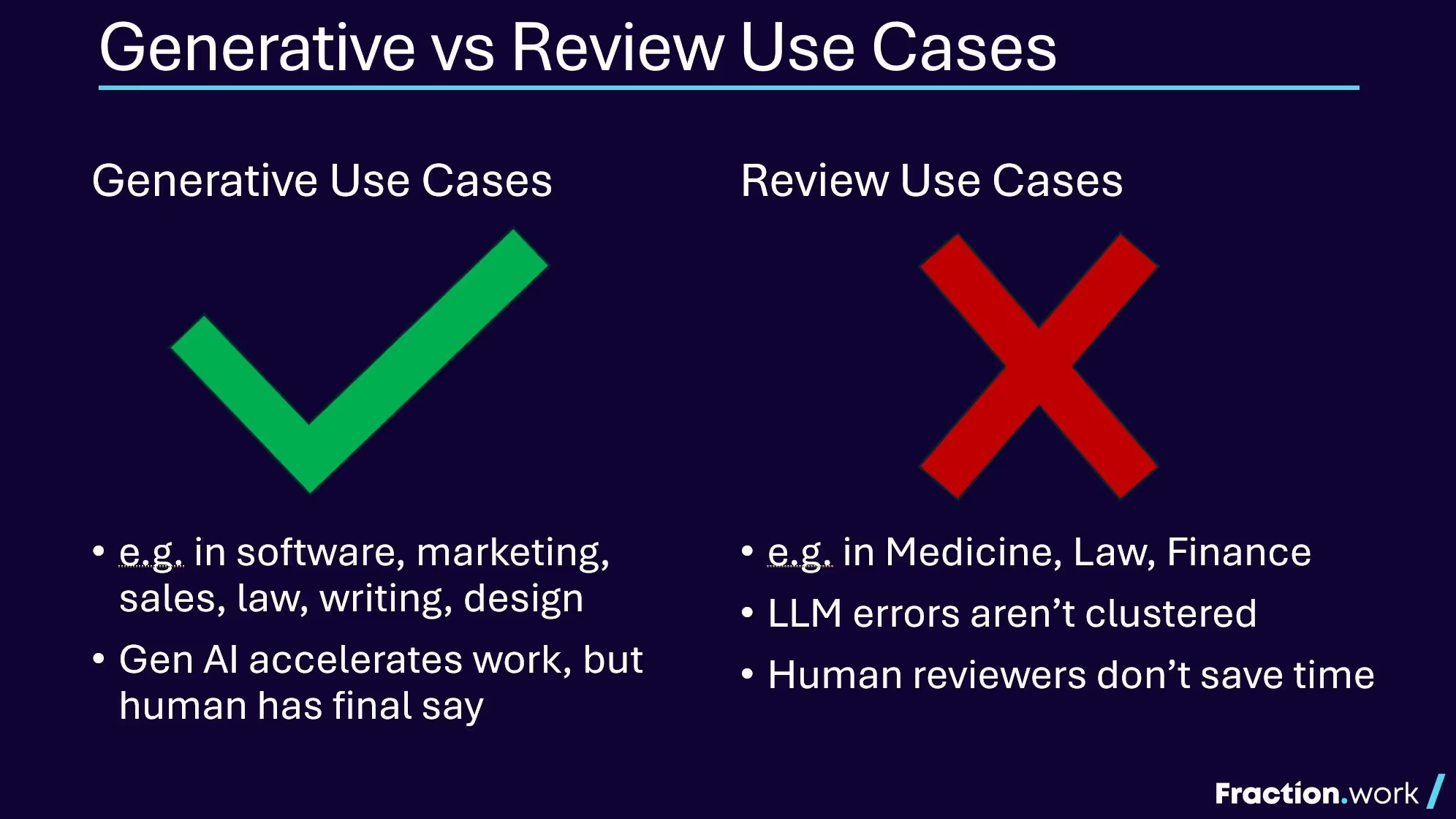
LLMs shine at generating content but stumble when asked to review it — and the distinction comes down to how probabilistic outputs interact with human trust.
Praveen Ghanta, CEO, Hire Fraction·July 15, 2024·8 min read
generative AIAI workflowLLM use caseshuman-AI collaboration
What you’ll learn
Why LLMs produce unpredictable, scattered errors in review tasks — and why that forces humans to check every output rather than a targeted subset
The exact trust failure that makes AI-assisted review counterproductive in high-stakes domains like healthcare and legal advisory
How advertising, publishing, and software development teams have quantified real productivity gains by using AI for content generation rather than content review
Why human-in-the-loop generative workflows consistently outperform fully automated review workflows in current AI systems
The specific technical milestone — predictable, clustered error patterns — that must be reached before LLM review use cases become reliably viable
The single most common mistake teams make when adopting AI tools is treating generative and review use cases as interchangeable. They are not. LLMs are designed to produce plausible output — and that design makes them exceptional at creating first drafts and terrible at catching errors in existing work. Understanding the difference is the difference between AI that saves time and AI that creates new problems.
Why do LLMs excel at generative tasks but struggle with review?
The answer lives in how large language models are built. LLMs are probabilistic systems trained to predict the next most-likely token given everything that came before it. That architecture is extraordinarily good at producing coherent, contextually relevant output from a prompt — which is precisely what generative tasks require.
Definition
Generative AI use case: an application where the AI produces original output — text, code, outlines, campaign copy — that a human then refines or validates, rather than asking the AI to evaluate or fact-check existing work. In generative workflows, human review is a natural downstream step; in review workflows, it becomes a redundant step that eliminates the efficiency gain.
The same probabilistic nature that makes LLMs fluent content producers makes them unreliable reviewers. In a review task, you’re asking the model to detect what is wrong with existing material — inconsistencies, factual errors, logical gaps. But the model has no ground truth against which to verify claims. It applies the same pattern-matching approach it uses to generate content, which means its errors in review mode are scattered and unpredictable rather than systematic and learnable.
The practical consequence: you cannot develop intuition about when the model will fail at review, so you cannot selectively spot-check its work. You must review everything. That eliminates the efficiency gain that made the use case appealing in the first place.
How are teams using generative AI to create content at scale?
Across industries, the clearest productivity wins from AI are in content generation — not content review. Marketing teams use tools like ChatGPT to draft campaign copy tailored to specific audience segments, brand voice guidelines, and market trends. Writers use AI to move past the blank page faster, generating outlines and first drafts that they then refine into finished pieces.
In research and development, enterprises have embedded LLMs to draft initial research summaries, accelerating the early phase of analysis work that previously required significant analyst hours. The AI produces a structured starting point; the human expert validates and extends it. The combination is faster than either working alone.
In advertising, campaigns that once required multiple rounds of creative concepting from human teams can now begin with AI-generated variations, allowing strategists to select, refine, and test ideas more rapidly. Publishers have used generative models to help authors move through early drafts faster — reducing the time cost of the generative phase without removing human authorship from the final product.
Software development teams, particularly at early-stage startups, have found generative AI especially valuable for code scaffolding. Generating boilerplate, proposing architecture patterns, and drafting API integrations are all tasks where AI dramatically reduces the time to first working version. Teams that have integrated generative AI into their development supply chain report material reductions in the time between conception and deployable prototype.
How does human-AI collaboration work best in creative workflows?
The most effective human-AI workflows follow a consistent structure: AI generates, humans refine and validate. This division of labor maps to what each party does well. AI removes the blank-page problem and produces volume quickly. Humans bring judgment, domain expertise, and the ability to detect subtle errors that a probabilistic model cannot reliably catch.
In creative contexts — marketing, content, education — this collaboration is particularly powerful because innovation is valued and a human review layer can comfortably catch errors before they reach an audience. An AI-drafted lesson plan or marketing email that contains a minor factual error is caught before publication. The workflow still produces a net efficiency gain because the human review is faster than the human creation would have been.
Industries benefit from this model in proportion to how much of their work involves producing original material at volume. The higher the volume demand and the lower the catastrophic cost of an individual error reaching a human editor, the more value generative AI delivers. Teams that have invested in building AI skills across their workforce tend to unlock this leverage faster, because individuals at every level know how to prompt effectively and evaluate AI output critically.
Ready to add AI to your product or workflow?
Fraction’s senior engineers and AI specialists scope and build AI-powered features with full story-point pricing — so you know exactly what you’re getting before work begins.
Why do LLMs fail at review tasks — and what makes errors so hard to catch?
The core problem with LLMs in review roles is the unpredictability of where errors appear. Unlike rule-based systems — which fail in consistent, learnable ways — LLMs fail seemingly at random across different types of input. One document might be reviewed correctly; a nearly identical document might receive a confidently wrong assessment.
This scattered error pattern has a compounding effect on trust. Human reviewers who discover that an LLM missed an obvious error in one document cannot assume the next document was reviewed correctly. They must check everything. The cognitive load of using an AI reviewer that cannot be trusted is often higher than reviewing without it, because you now have to evaluate both the original content and the AI’s claims about it.
The absence of error clustering is the technical root of this problem. Clustered errors — where a model consistently fails on a specific type of input — are manageable. You learn the failure mode and build a workflow around it. Scattered errors are not manageable in the same way, because there is no pattern to learn and no targeted mitigation to apply.
This doesn’t mean LLMs have no role near review workflows. AI can flag potential issues for human attention — essentially serving as a first-pass triage tool that surfaces candidates for review rather than making final judgments. But that is a generative assist function, not a true review replacement. Organizations exploring how to integrate AI into structured evaluation processes like recruiting are discovering the same pattern: AI excels at generating drafts and shortlists, but final review decisions still require human judgment.
What happens when you use LLMs for review in high-stakes domains?
In fields where errors carry serious consequences — medicine, law, financial compliance — the limitations of LLM review are not just efficiency problems. They are safety and liability problems.
Consider medical diagnosis. Healthcare professionals exploring AI-assisted diagnostic review face a specific challenge: LLMs do not flag anomalies consistently. A particular imaging result or symptom cluster that indicates a serious condition might be correctly identified in one case and completely missed in another. Because clinicians cannot predict which cases the AI will handle correctly, they must review each AI output with the same rigor they would apply without AI assistance.
The result is a workflow that adds a step — reviewing the AI’s review — without removing the original step of expert human review. In some cases, it adds risk, because a practitioner might unconsciously anchor on the AI’s assessment even when it is wrong. The human becomes less skeptical of the underlying material precisely because a review was nominally performed.
Until LLMs can demonstrate error predictability — showing that their failures cluster around identifiable input types that practitioners can learn to flag — autonomous AI review in high-stakes domains will remain out of reach. The current state of the technology confines its role in medicine, law, and compliance to generative support: summarizing records, drafting reports, suggesting documentation language, rather than making or validating final judgments.
When will AI review use cases become reliable enough to trust?
The path to trustworthy AI review runs through error predictability. The technical milestone that would unlock review use cases at scale is not raw accuracy improvement — it is consistency of failure modes. If practitioners could learn that a given model reliably fails on ambiguous inputs or novel phrasings, they could build selective review workflows around those known weak spots, dramatically reducing the overhead of human verification.
Ongoing research in model interpretability, calibration, and uncertainty quantification is moving toward this goal. Better-calibrated models express lower confidence on inputs where they are likely to fail, which would allow downstream systems to route uncertain outputs to human reviewers automatically. That would effectively recreate the clustered-error pattern that makes review workflows manageable.
In the near term — through at least the mid-2020s — the productive strategy is to lean into generative applications while building the organizational habits and quality control infrastructure that will make AI review viable when the technology catches up. Teams that become fluent in generative AI workflows now will be better positioned to extend that fluency into review applications as reliability improves.
The goal is not to wait for perfect AI review. It is to extract maximum value from what AI does well today — generating content, accelerating ideation, removing blank-page friction — while maintaining honest expectations about what it cannot yet reliably do: serve as a final check on existing work without meaningful human oversight.
Frequently asked questions
Why are LLMs better at generating content than reviewing it?
LLMs are probabilistic systems — they generate plausible output based on patterns in training data, rather than applying deterministic logic. In generative tasks, that probabilistic nature produces creative, varied output that humans can then refine. In review tasks, the same probabilistic nature means errors are scattered unpredictably across outputs, forcing humans to verify every result individually. The efficiency gain disappears because you can’t selectively review only the flagged cases.
What types of generative AI tasks produce the biggest productivity gains?
The highest-leverage generative applications are those where human refinement of AI drafts is faster than writing from scratch, and where the cost of an occasional error is low. These include first-draft content creation (marketing copy, research summaries, lesson plans), code scaffolding, personalized outreach at scale, and ideation for creative campaigns. Industries like advertising, publishing, and software development have documented significant time savings when AI generates the initial version and humans handle refinement.
Why can't LLMs be trusted to review high-stakes content like medical diagnoses?
In high-stakes domains, the cost of an undetected error is severe — a missed diagnosis or an incorrect legal conclusion can cause direct harm. LLMs in review roles don’t produce consistent, predictable errors that practitioners can learn to spot and correct. Because failures are scattered and unpredictable, clinicians or legal professionals cannot safely rely on the AI to flag only true problems. They must review every output themselves, which eliminates the efficiency benefit and adds a layer of false confidence risk.
What does "predictable error clustering" mean and why does it matter for AI review?
Predictable error clustering means that an AI system fails in consistent, identifiable ways — the same types of inputs reliably produce the same types of mistakes. If errors were clustered, practitioners could learn the model’s weak spots and selectively review only those categories of output. Current LLMs don’t exhibit this behavior: their errors appear seemingly at random across different contexts, which is why human reviewers must check all output rather than a targeted subset.
How should teams structure human-AI workflows to get the most from generative AI?
The highest-performing structure positions AI as the generator and humans as the refiner and validator. AI produces a first draft — whether text, code, or a research outline — and a human edits for accuracy, tone, and completeness. This structure works because it removes the blank-page problem, reduces the raw time cost of production, and keeps error detection in human hands where it is most reliable. Avoid workflows where AI is asked to make final judgments without a human review step.
Praveen Ghanta
CEO, Hire Fraction
Praveen Ghanta is a five-time founder and serial entrepreneur. He is the founder of DevHawk.ai, an AI-powered engineering management platform, and Fraction.work, which connects fast-growing companies with top fractional tech and growth marketing talent. Previously, he founded HiddenLevers, a risk analytics platform for wealth management that he bootstrapped from inception to acquisition by Orion Advisor Solutions in 2021, serving thousands of advisors and $600B in assets. He earlier founded SmartWorkGroups, acquired by Intralinks in 2000.
Describe your software or AI project. Get a full scope with story-point pricing, sprint estimates, and a downloadable plan in minutes. No calls, no waiting.