Oops! Something went wrong while submitting the form.
By providing a telephone number and submitting this form you are consenting to be contacted by SMS text message. Message & data rates may apply. You can reply STOP to opt-out of further messaging.
Fractional Hiring
Why Fraction's Developers Outperform
Skill level matters more than hours worked — and a decade of building with senior fractional developers proves it.
Praveen Ghanta, CEO, Hire Fraction·April 5, 2023·5 min read
Why skill level matters far more than hours worked when evaluating developer productivity
How Fraction’s 100% senior talent model creates a measurable output advantage
Why architecture and PM oversight remove the hidden blockers that slow most development teams
What being 100% US-based means beyond time zones — domain knowledge and market fluency
How industry experience from a 50x talent pool accelerates onboarding in specialized verticals
After a decade of building software companies, the pattern is consistent: senior developers working 20 hours per week get more done than junior and mid-level developers working 40. Hours matter less than skill. Fraction is built entirely on this insight.
Can an elite developer working part-time outperform a full-time hire?
Yes — and it is not close. The productivity gap between a developer with 12 years of experience and one with 2 is far larger than the gap between 20 and 40 hours per week. A senior developer knows the patterns, avoids the traps, and makes the right architectural call on the first try. A junior developer is still learning all three.
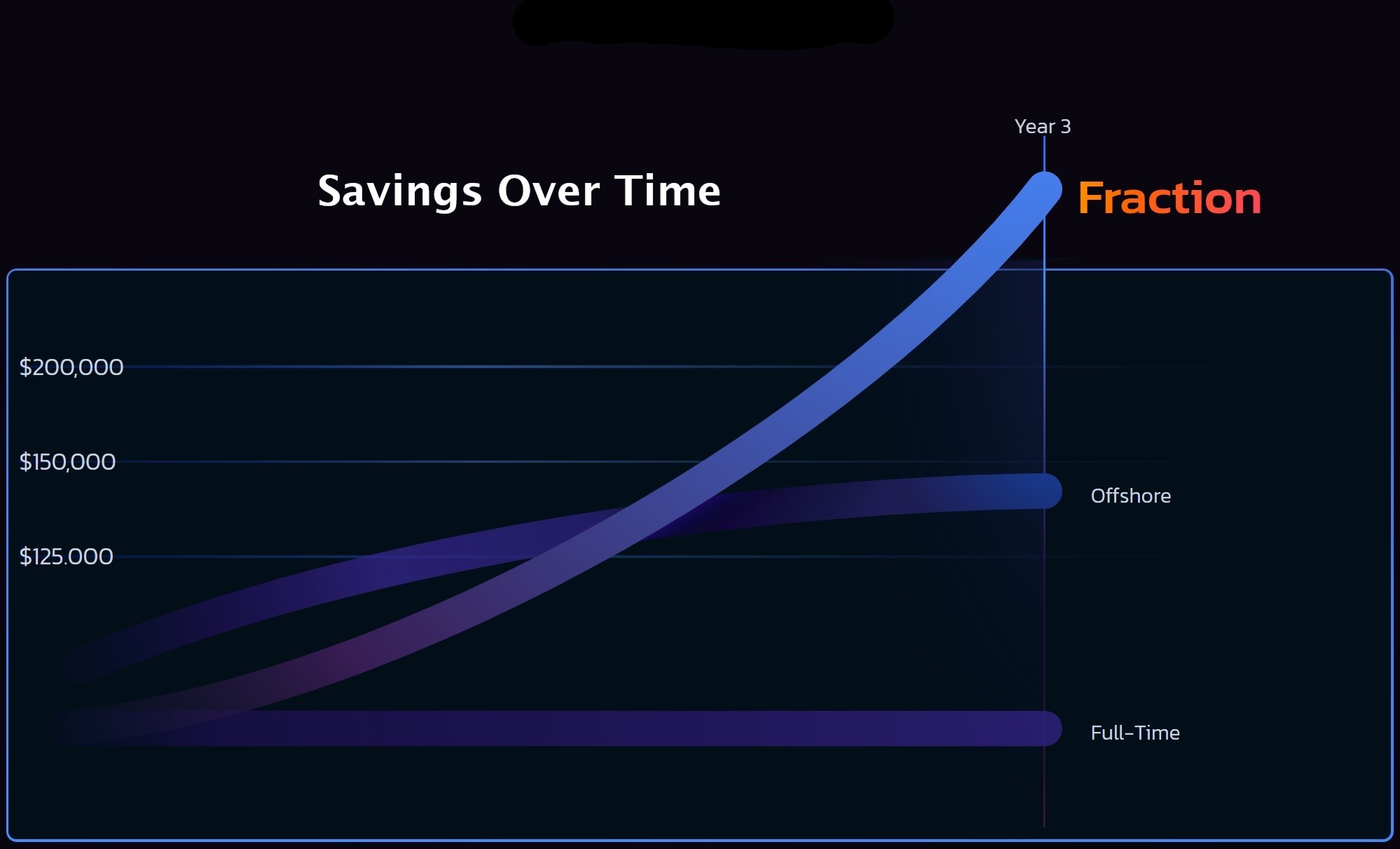
This is not a theoretical claim. After a decade running senior fractional developers on real product work, the data is consistent: senior fractional developers in a structured delivery model routinely outdeliver typical full-time teams — and do it at lower total cost when you account for the overhead that full-time employment carries.
Definition
Fractional developer: an experienced software engineer who works a defined number of hours per week — typically 20 — embedded in a client’s team. Unlike a contractor, a fractional developer works within a structured delivery model that includes architecture oversight and product management support.
What are fractional developers and how does the model work?
Fractional developers are experienced software engineers who work 20 hours per week. For founders, this opens access to full-time senior engineers without the overhead that full-time employment adds — benefits, payroll taxes, bonus, and equity can easily total one-third of base salary on top of cash compensation.
To make the model work at scale, Fraction built a delivery framework around it. Every engagement includes project management, product management, and software architecture guidance. This is not optional overhead — it is what separates a fractional model that works from one that does not. Fraction combines 100% US-based senior developers with this delivery overlay to outperform offshore, nearshore, and domestic outsourcing options on a price-performance basis.
Model
Typical composition
Relative productivity
Key overhead
Fraction (fractional)
100% senior, US-based, with PM + architecture overlay
Why does 100% senior talent make such a large productivity difference?
Most teams — in-house or outsourced — are composed of a mix of junior, mid-level, and senior developers. Senior developers are typically many times more productive than junior developers who are still learning. Fraction works exclusively with senior engineers, averaging 12 years of experience across the team.
The lift from this alone is substantial. You remove the ramp-up time, the repeated mistakes, the architectural decisions that have to be undone later, and the hand-holding that slows down everyone nearby. When every developer on a project is senior, the team moves at a categorically different speed.
You will see many firms claim “the top 3% of developers” or “the top 1%.” At some point these claims become noise. The more grounded question is: what does the composition of the team actually look like? Fraction’s answer is concrete — every developer is senior, and the average tenure is 12 years.
How does the architecture and PM overlay remove hidden blockers?
On a typical software project, a significant percentage of blockers are not technical problems — they are product decisions. When a developer hits an ambiguous requirement or a decision that requires business context, work stops. Or worse, the developer guesses wrong and the team spends days undoing it.
Fraction includes software architecture and product management guidance with every developer. Fraction PMs understand clients’ business objectives and remove hurdles proactively before they stall development. Architecture reviews catch tech debt early and prevent the kind of nasty surprises that derail timelines later.
This overlay is what makes the fractional model reliable at scale. Without it, part-time engagement creates coordination gaps. With it, the developer’s 20 hours are spent building — not waiting, not backtracking, not making product decisions that belong to someone else.
Why does being 100% US-based matter beyond time zones?
In an ideal world, every product is developed as close to its customers as possible. Timezone alignment and communication fluency matter — but they are table stakes. The deeper advantage of US-based developers is domain knowledge.
A developer who has worked in US healthcare, US insurance, or US financial services as a customer understands those markets implicitly. They know how US addresses are formatted, why products are measured in pounds and ounces, what HIPAA compliance actually looks like in practice, and how US financial regulations shape product decisions. Offshore teams have to be explicitly taught all of this — if they can be taught it at all.
This kind of tacit market knowledge cannot be documented in a spec. It shows up in thousands of small decisions that, collectively, determine whether a product feels native to US users or slightly foreign. Fraction’s 100% US-based model ensures it is never missing.
How does industry experience from a larger talent pool accelerate delivery?
Industry experience can be decisive — and since Fraction draws from a talent pool roughly 50 times larger than a typical local hiring market, it can match both technical skill and prior industry experience simultaneously.
For clients serving specific industry verticals — healthcare, fintech, logistics, insurance, legal — this matters enormously. A developer who has already built inside your industry arrives with context that would take months to build otherwise. They recognize the compliance requirements, understand the integration patterns, and know the failure modes that are specific to your domain.
Fraction has found that relative to typical offshore teams, this delivery model — 100% senior talent, architecture and PM overlay, US-based, with matching industry experience — can be as much as 3x more productive. The largest component of that outperformance is the all-senior model. Everything else compounds on top of it.
Frequently asked questions
Can a part-time developer really outperform a full-time hire?
Yes, when skill level is dramatically higher. A senior developer working 20 hours per week routinely delivers more output than a junior or mid-level developer working 40 hours. The productivity gap between a 12-year veteran and an early-career developer is far larger than the gap between 20 and 40 hours. Fraction’s model is built on this principle: 100% senior talent at fractional hours consistently outperforms typical full-time teams on a price-performance basis.
What makes Fraction's developers different from other outsourcing options?
Three things distinguish Fraction: all developers are senior with an average of 12 years of experience, all are 100% US-based, and every engagement includes architecture and product management oversight. Most outsourced or in-house teams mix junior, mid-level, and senior talent. Fraction’s all-senior model removes the productivity drag caused by developers who are still learning on the job.
Why does Fraction include project management and architecture in every engagement?
Because a large percentage of development blockers are not technical problems — they are product decisions. When a developer hits a decision point and has no one to escalate to, work stops or the wrong choice gets made. Fraction’s PMs and architects remove these blockers proactively, so developers spend their hours building rather than waiting. This overlay also catches technical debt early before it compounds into expensive refactors.
Does being US-based actually matter for development quality?
It matters more than most founders expect. Beyond eliminating timezone friction and communication delays, US-based developers bring implicit domain knowledge about US markets, regulations, and user expectations. A developer who has worked inside US healthcare, financial services, or insurance products understands context that offshore teams have to be explicitly taught — if they can be taught it at all.
How does Fraction compare to offshore or nearshore development teams on cost?
Fraction competes on price-performance, not on raw hourly rate. Offshore teams are cheaper per hour but typically deliver far less per dollar because they mix experience levels and suffer from timezone and communication overhead. Fraction’s all-senior model, combined with architecture and PM overlay, has been shown to deliver up to 3x the productivity of a typical offshore team — making the effective cost per unit of output competitive or better.
What industries does Fraction have experience in?
Fraction draws from a talent pool roughly 50 times larger than a typical local hiring market, which means it can match both technical skill and prior industry experience. Clients in healthcare, fintech, insurance, logistics, and other regulated verticals benefit from developers who already understand domain-specific requirements — reducing onboarding time and the risk of costly misunderstandings.
Praveen Ghanta
CEO, Hire Fraction
Praveen Ghanta is a five-time founder and serial entrepreneur. He is the founder of DevHawk.ai, an AI-powered engineering management platform, and Fraction.work, which connects fast-growing companies with top fractional tech and growth marketing talent. Previously, he founded HiddenLevers, a risk analytics platform for wealth management that he bootstrapped from inception to acquisition by Orion Advisor Solutions in 2021, serving thousands of advisors and $600B in assets. He earlier founded SmartWorkGroups, acquired by Intralinks in 2000.
Describe your software or AI project. Get a full scope with story-point pricing, sprint estimates, and a downloadable plan in minutes. No calls, no waiting.