Oops! Something went wrong while submitting the form.
By providing a telephone number and submitting this form you are consenting to be contacted by SMS text message. Message & data rates may apply. You can reply STOP to opt-out of further messaging.
Startup Economics
Why You Should Brain Date: Reflections from SaaStr 2022
Twenty-plus brain dates, nearly 10,000 founders, and one clear lesson: the conversations you plan beat the ones you stumble into.
Praveen Ghanta, CEO, Hire Fraction·September 20, 2022·5 min read
SaaStr 2022brain datesstartup networkingfounder conferencesSaaS community
What you’ll learn
What a brain date is and why the format works better than traditional conference networking
How Fraction used brain dates at SaaStr 2022 to build real relationships at scale
Which topics generate the most useful brain date conversations
How to prepare before the event so you get maximum value from every session
Why in-person conferences still matter for early-stage startup founders
Reid Hoffman once said, “One lunch is worth dozens of emails.” We went to SaaStr 2022 expecting a conference. What we got was proof that he was right — and that the format matters more than the venue.
What is a brain date and how does the format work?
Definition
Brain date: a structured, topic-based one-on-one or small-group networking session in which attendees post specific subjects they want to discuss or have expertise in, and are matched with others based on shared interests or challenges.
The SaaStr brain date platform runs on a simple premise: the best conference conversations happen when both parties already know what they are there to talk about. Instead of wandering the expo floor hoping to bump into someone useful, you post a topic — or browse topics others have posted — and schedule a focused 20- to 30-minute session in advance.
At SaaStr 2022, over 450 brain date topics were active across subjects ranging from digital marketing and outbound sales to fundraising strategy and product positioning. The platform makes it easy to search by theme, see who is hosting each session, and book directly into their calendar.
The result is that by the time you sit down, you are already talking about something that matters to at least one of you. That changes the entire conversation dynamic.
Why do brain dates outperform regular conference networking?
Standard conference networking has a structural problem: it rewards surface-level interaction. You collect badges. You shake hands. You say “let’s connect on LinkedIn” and then neither of you follows up. The conversations are short because neither party has a reason to go deep, and the time pressure of a crowded room keeps everything at the level of elevator pitches.
Brain dates solve this in three ways. First, they are intentional — both parties chose the topic, which means both parties care. Second, they are scheduled, which removes the awkwardness of approaching strangers and creates a protected block of time. Third, the small format (usually one-on-one or a group of three to four) allows for the kind of candid back-and-forth that simply does not happen in a hallway.
The conversations we had through brain dates at SaaStr 2022 went places that a typical conference exchange never reaches. People shared actual numbers. They described real failures. They asked specific questions they had been sitting on for months. That is the difference between a transactional network and a genuine professional relationship.
How did Fraction use brain dates at SaaStr 2022?
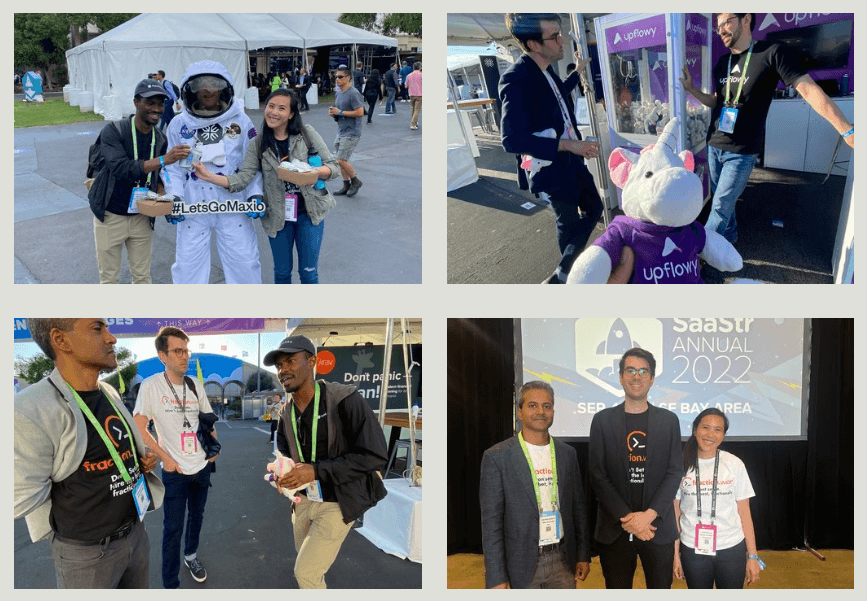
We attended SaaStr 2022 as our first major in-person event post-COVID, and we went in with a deliberate strategy: prioritize brain dates over main-stage sessions. The presentations on the big stages are valuable, but they are also recorded, summarized, and distributed widely within days. The brain dates are not.
Over the course of the conference, the Fraction team participated in more than 20 brain dates covering topics like email outreach strategies, product positioning, and leading discussions on bootstrapping to exit. We both attended sessions others had posted and hosted our own on topics where we had specific experience to share.
The sessions where we hosted were particularly valuable. When you post a topic, you attract exactly the people who care about that specific problem. The pre-selection does the filtering work that normally takes months of follow-up emails to accomplish.
We also built relationships the old-fashioned way — over shared meals and the SaaStr Nights happy hours. But the brain dates created a foundation of substance that made those casual conversations immediately more productive. We were not meeting for the first time at dinner; we were continuing conversations that had already started.
Building a SaaS company and need senior talent?
Fraction embeds senior engineers, designers, and growth operators inside startups as fractional hires — no headcount, no overhead.
What topics generate the most useful brain date conversations?
The most productive brain dates we experienced had one thing in common: a specific, named problem. Not “let’s talk about growth” but “I am trying to improve reply rates on cold outbound to VP-level buyers — what subject lines and first lines are working for you right now?”
Specificity signals to potential brain date partners that you have already thought about the problem and will be a useful conversation partner in return. Vague topics attract vague conversations. A sharp topic attracts people who have already solved the problem or are actively working through the same challenge.
The topics that generated the most useful sessions at SaaStr 2022 fell into a few categories: sales process questions (sequencing, ICP refinement, pricing conversations), product positioning for narrow versus broad markets, and the bootstrapping versus venture capital decision at various stages. These are subjects where there is no single right answer and where hearing from operators who have made the call — in either direction — is genuinely more valuable than any framework article.
How should a founder prepare before attending SaaStr?
The founders who get the most from SaaStr treat it as a working trip, not a spectator event. The main stage programming is a backdrop. The real work happens in the margins.
Before you arrive, write down the two or three hardest problems your company is facing right now. Not general themes — specific, named challenges with context. Then open the brain date platform as soon as it goes live and book sessions around those problems. The best topics fill up early, and showing up on day one without any brain dates scheduled means competing for whatever is left.
Also identify five to ten specific people you want to meet — founders a stage or two ahead of you who have navigated something you are about to face. Send a brief, honest note before the conference explaining exactly why you want to connect. Most people will respond to a specific request far more readily than a generic “I’d love to grab coffee.”
Finally, come prepared to share, not just receive. The best brain date sessions are exchanges. Know what you have learned that other people would find useful. The person across from you is also trying to get value from the conversation, and the sessions where both parties leave with something concrete are the ones that turn into lasting professional relationships.
Frequently asked questions
What is a brain date at SaaStr?
A brain date is a structured, topic-based networking session offered at SaaStr events. Attendees post specific topics they want to discuss or have expertise in, and the platform matches them with others who share those interests or challenges. Sessions are typically small — one to a few people — which allows for genuine, focused conversation rather than the surface-level exchanges common at large conference booths.
How do brain dates differ from standard conference networking?
Standard conference networking is largely passive — you collect badges, exchange pleasantries, and follow up with people you happened to stand next to. Brain dates are intentional. You know ahead of time what topic you are discussing and who you are meeting, which means the conversation starts at a useful level rather than spending twenty minutes on small talk. The resulting relationships tend to be more substantive and faster to develop.
Is SaaStr worth attending for early-stage startup founders?
Yes, particularly for the brain dates and hallway conversations rather than the main stage presentations. The main stage advice tends to be general and well-documented elsewhere. The value is in one-on-one and small-group conversations with operators who are solving problems similar to yours. If you attend with a clear agenda — specific problems you want input on, specific types of people you want to meet — the ROI is high relative to most conference investments.
What topics work well for brain dates?
Topics that work best are specific and actionable: outbound email sequencing strategies, pricing model transitions, what to look for in a first VP of Sales hire, bootstrapping versus raising a seed round. Topics that are too broad — ‘growth’ or ‘product strategy’ — lead to unfocused sessions. The more precisely you can name a problem you are working through, the more useful the conversation will be.
How should a startup prepare before attending SaaStr?
Come with a short list of the two or three hardest problems your company is facing right now. Review the brain date topic board before the event starts and book sessions early — the best topics fill up. Identify five to ten specific people you want to meet and have a concise, honest description of what you are building and what you are struggling with. The founders who get the most from SaaStr treat it as a working trip, not a spectator event.
Can you build real partnerships at a conference like SaaStr?
Yes — but the partnership does not happen at the conference. It starts there. A meaningful in-person conversation creates a context that email and LinkedIn cannot replicate, and that context makes the follow-up conversation feel like a continuation rather than a cold outreach. The founders and operators we met at SaaStr 2022 through brain dates and shared meals became genuine connections we stayed in contact with. The conference is the starting point, not the endpoint.
Praveen Ghanta is a five-time founder and serial entrepreneur. He is the founder of DevHawk.ai, an AI-powered engineering management platform, and Fraction.work, which connects fast-growing companies with top fractional tech and growth marketing talent. Previously, he founded HiddenLevers, a risk analytics platform for wealth management that he bootstrapped from inception to acquisition by Orion Advisor Solutions in 2021, serving thousands of advisors and $600B in assets. He earlier founded SmartWorkGroups, acquired by Intralinks in 2000.
Describe your software or AI project. Get a full scope with story-point pricing, sprint estimates, and a downloadable plan in minutes. No calls, no waiting.