Oops! Something went wrong while submitting the form.
By providing a telephone number and submitting this form you are consenting to be contacted by SMS text message. Message & data rates may apply. You can reply STOP to opt-out of further messaging.
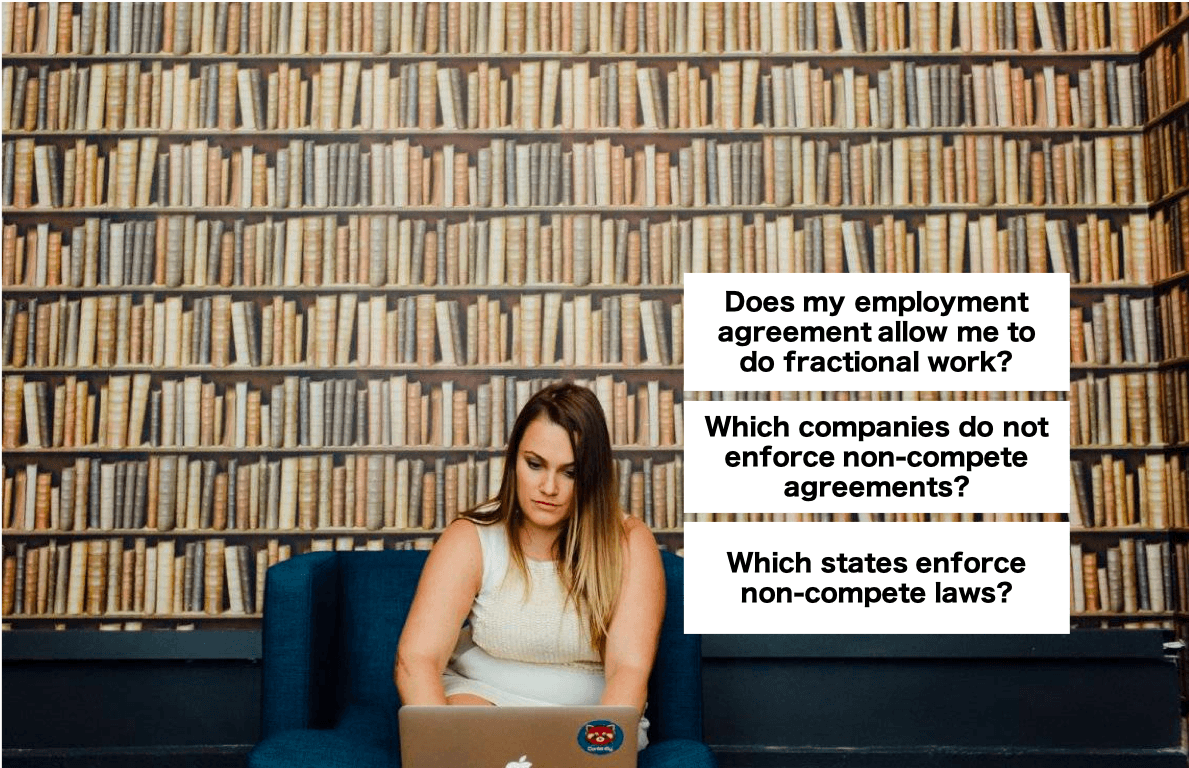
The three categories of employment agreements Fraction encounters — and which ones actually block fractional work
Exactly how IP ownership risk arises when a fractional developer is also a full-time employee elsewhere
Which three US states ban non-compete agreements outright, eliminating the issue for developers in those states
How Fraction’s industry silo process protects both clients and developers from non-compete violations
What Microsoft’s non-compete policy change means for the pool of available fractional developer talent
When companies hear about fractional software development, legal objections come up immediately: “What if the developer has a non-compete?” “Who owns the IP they write for us?” These are fair questions — and the answer is more manageable than most people expect.
What do non-compete agreements and intellectual property clauses actually mean?
Definition
Non-compete agreement: a contract between an employer and an employee that prohibits the employee from competing with the business directly or indirectly for a specific duration of time after their employment ends. Scope varies widely — from narrow lists of named competitors to broad geographic or industry-wide restrictions. (Cornell Law)
Intellectual property in employment contracts works similarly: employers often claim ownership of anything an employee creates during the employment relationship, sometimes regardless of whether company time or equipment was used. Under US IP law, this typically covers inventions, software, designs, and other work product — which is exactly what a fractional developer produces for clients.
Fractional software development at Fraction is specifically long-term and part-time — not project-based gig work. Like full-time roles, fractional roles are open-ended with no defined end date. This distinction matters legally because it means fractional developers are engaged in ongoing work product creation, which can intersect with both non-compete and IP provisions in their primary employment agreements.
How does intellectual property ownership work in a fractional developer engagement?
Any client working with a fractional developer has a baseline expectation: they own all work product and IP generated during the engagement. Fraction’s standard agreement assigns all work product and IP to the client, which covers the consulting relationship cleanly.
The risk arises in a specific scenario: if a fractional developer is also a full-time employee at another organization that claims ownership of all employee IP — regardless of whether the work was done on company time or using company equipment. In that case, there could be a conflict between what Fraction’s agreement promises the client and what the developer’s primary employer claims to own.
This isn’t theoretical. Some large tech employers write IP assignment clauses broadly enough to capture work done entirely on personal time with personal equipment. Fraction screens for this as part of its matching process, and understanding how Fraction handles IP and scam objections is an important part of evaluating whether fractional work is right for your company.
How do non-compete agreements affect a developer’s ability to take fractional work?
Non-compete agreements typically bar employees from working for companies within the employer’s industry or a defined geography. The specificity of that definition is everything. Broad contracts define this as the entire country (or world) and virtually any employer — making most outside work a technical violation. Narrow non-competes list an explicit set of named competitors.
For fractional work, the key question is whether a developer’s primary employer would consider their fractional client a competitor. A senior engineer at a fintech company taking on fractional work for a healthcare SaaS startup probably clears the bar. The same engineer working fractionally for another fintech company in the same market likely does not.
Not sure if your situation qualifies?
Fraction evaluates developer employment agreements as part of the matching process, so you don’t have to figure out the legal landscape on your own.
What are the three types of employment agreements Fraction encounters?
In reviewing developer employment agreements, Fraction has found that most contracts fall into one of three categories:
Agreement Type
What It Allows
Fraction Match?
Flexible
Outside work and IP assignment allowed, provided employee doesn’t use company time or equipment
Yes — any client
Manageable
Outside work allowed as long as it’s in a different industry vertical with no overlap with employer’s business
Yes — with industry silo matching
Strict
Claims ownership of all IP; attempts to ban any outside employment
Generally no — with exceptions
The first two types are manageable in practice. Developers with flexible agreements can work for any client without issue. Developers with manageable agreements go through Fraction’s industry silo process, which ensures they are matched only with clients in industry verticals that don’t conflict with their primary employer’s business.
Developers with strict employment agreements generally cannot be matched — but there are notable exceptions. State law often overrides contractual restrictions, which is where the geography of the developer’s work matters significantly. If you’re looking for guidance on how to get the most out of a fractional engagement, understanding this matching process upfront sets better expectations.
Which states ban non-competes, and what do recent company policy changes mean for fractional talent?
Three US states broadly ban non-compete agreements: California, Oklahoma, and North Dakota. For developers based in these states, most non-compete provisions in their employment agreements are legally unenforceable — which significantly simplifies the matching process and expands what’s possible.
Beyond these three states, enforcement and scope vary considerably. Beck Reed & Riden LLP, a law firm specializing in employment law, maintains an updated 50-state non-compete law chart that details each state’s approach. Several other states have moved to narrow or limit enforcement of non-compete provisions in recent years.
Corporate policy changes have also shifted the landscape. Microsoft announced it was ending the use of non-compete agreements below the Partner (senior management) level — freeing most Microsoft employees from these restrictions in a way that mirrors how California employees were already treated. This kind of policy change materially expands the pool of qualified senior developers who can legally take on fractional work. The question of developer availability in fractional hiring is directly connected to how these legal constraints evolve.
What is the practical bottom line on legal hurdles for fractional software development?
Non-compete and IP assignment clauses look like significant obstacles in the abstract. In practice at Fraction, they have posed little barrier to finding qualified senior developer talent for clients. The reasons are straightforward: most employment agreements fall into the flexible or manageable categories, state law limits enforcement in a growing number of jurisdictions, and corporate policy is trending toward fewer restrictions.
Fraction undertakes due diligence on employment agreements as a standard part of the matching process — so clients don’t have to navigate this themselves. With a large pool of senior developers actively seeking fractional engagements, the legal framework is a solvable problem, not a disqualifying one.
Disclaimer: This post was prepared by Fraction for informational purposes only and does not constitute legal advice. Readers should not act on this information without seeking professional legal counsel for their specific situation.
Frequently asked questions
Can a developer do fractional work if they have a non-compete agreement? It depends on the type of agreement. Most employment contracts fall into one of three categories: flexible agreements that allow outside work as long as company resources aren’t used, manageable agreements that allow outside work in different industry verticals, and strict agreements that attempt to restrict all outside employment. Fraction uses an industry silo process to match developers with manageable agreements to appropriate clients, and developers in strict agreements generally cannot be matched — though there are exceptions based on state law. Who owns the intellectual property when a fractional developer builds something for a client? Clients always retain ownership of all work product and IP generated during a Fraction engagement. The standard agreement explicitly assigns all work product and IP to the client. However, a risk arises if the fractional developer is an employee of another organization that claims ownership of employee IP regardless of when or where the work was done. Fraction screens for this and uses its matching process to ensure IP ownership is clean. Which states ban non-compete agreements? California, Oklahoma, and North Dakota broadly ban non-compete agreements, which simplifies the issue for developers based in those states. Beyond these three, enforcement and scope varies significantly by state. Beck Reed & Riden LLP maintains a regularly updated 50-state non-compete law chart that outlines how each state handles these agreements. What is the difference between a "flexible" and a "strict" employment agreement for fractional developers? Flexible agreements allow employees to work outside their employer and own or assign IP, provided they do not use company time or equipment. Manageable agreements permit outside work as long as it is in a different industry vertical. Strict agreements attempt to claim ownership of all IP and prohibit any outside employment. Fraction can match developers under the first two types of agreements; strict agreements typically prevent matching unless state law overrides the restriction. Does Fraction do due diligence on developer employment agreements before matching? Yes. Fraction reviews developer employment agreements as part of the matching process and uses an industry silo system to ensure that developers with manageable agreements are placed only in engagements that do not conflict with their primary employer’s business. This protects both the client’s IP ownership expectations and the developer’s compliance obligations. Has Microsoft's policy change on non-competes affected fractional developer availability? Yes, positively. Microsoft announced it was ending the use of non-compete agreements below the Partner (senior management) level. This freed most Microsoft employees from non-compete restrictions in a way similar to how California law already treated them, broadening the pool of senior developers who can legally take on fractional engagements.
Praveen Ghanta is a five-time founder and serial entrepreneur. He is the founder of DevHawk.ai, an AI-powered engineering management platform, and Fraction.work, which connects fast-growing companies with top fractional tech and growth marketing talent. Previously, he founded HiddenLevers, a risk analytics platform for wealth management that he bootstrapped from inception to acquisition by Orion Advisor Solutions in 2021, serving thousands of advisors and $600B in assets. He earlier founded SmartWorkGroups, acquired by Intralinks in 2000.
Describe your software or AI project. Get a full scope with story-point pricing, sprint estimates, and a downloadable plan in minutes. No calls, no waiting.