Oops! Something went wrong while submitting the form.
By providing a telephone number and submitting this form you are consenting to be contacted by SMS text message. Message & data rates may apply. You can reply STOP to opt-out of further messaging.
AI Tools
Non-LLM Based Machine Learning
LLMs dominate the conversation, but purpose-built ML models — OCR, classifiers, CNNs — deliver higher accuracy at a fraction of the cost for most real engineering tasks.
Praveen Ghanta, CEO, Hire Fraction·July 18, 2024·7 min read
machine learningOCRclassificationopen source ML
What you’ll learn
Why OCR models achieve 98% accuracy or higher on document processing — and why an LLM would cost more and perform worse on the same task
The five non-LLM classifier types (Bayesian, Decision Tree, SVM, KNN, CNN) and exactly which problem shapes each one handles best
How HuggingFace lets a full stack engineer deploy a pre-trained ML model in days without a dedicated ML team
The real cost difference between running a purpose-built cloud model versus a general-purpose LLM API at scale
What a large-scale microfilm ingestion project proves about when specialized models outperform generalized AI
The spotlight in ML almost always lands on large language models. But for engineers working on document processing, image recognition, or structured data classification, defaulting to an LLM is often the wrong call — and an expensive one. Purpose-built, non-LLM models are faster, cheaper, and more accurate for most well-defined tasks.
What is non-LLM based machine learning, and how does it differ from generative AI?
The landscape of machine learning extends far beyond LLM-based solutions. Non-LLM machine learning encompasses a broad set of techniques and algorithms that have been in production use for years — decision trees, random forests, support vector machines, clustering algorithms, and specialized neural networks built for specific tasks.
Definition
Non-LLM machine learning: a category of ML methods that do not rely on large language models or generative AI. These include classical supervised and unsupervised learning algorithms (regression, decision trees, SVMs, k-means clustering) and task-specific neural networks (CNNs for vision, OCR models for text extraction). Unlike LLMs, they are trained on narrow, domain-specific data and optimized for a single type of prediction or transformation — not open-ended text generation.
Instead of generalizing across tasks, non-LLM models excel at targeted predictions and classifications. This precision is crucial for applications involving structured data, image content, or specific problem domains where the input and output types are well-defined. By leveraging these techniques, engineers can build robust, scalable solutions without the compute overhead of a generative model.
Full stack engineers now have access to a wealth of pre-trained non-LLM models through platforms like HuggingFace, which hosts thousands of ready-to-deploy models across vision, audio, NLP classification, and more. This availability has democratized practical ML, removing the need for a specialized research team to ship a working model.
Why does non-LLM machine learning give full stack engineers a meaningful edge?
Full stack engineers gain a significant advantage when they can deploy specialized ML models directly within their existing tech stacks — without waiting on an ML team or retraining a model from scratch. Non-LLM approaches enable exactly this.
The most immediate benefit is operational cost. Generalized LLMs charge per token, and costs compound rapidly at scale. A classification model or OCR pipeline running in the cloud processes the same workload at a fraction of the API cost. Teams that have made this switch consistently report that purpose-built models deliver higher accuracy at lower expense for their specific use case.
Another benefit is reduced complexity. Non-LLM models have predictable input/output contracts. Unlike prompt-driven systems, they don’t require ongoing prompt engineering, output parsing, or guardrails against hallucination. This makes them easier to test, easier to monitor, and easier to hand off.
For teams that need specialized ML expertise they don’t have in-house — whether for model selection, fine-tuning, or deployment architecture — understanding the real cost structure of AI development helps set realistic expectations before engaging vendors or hiring.
What are the most useful non-LLM ML techniques, and when should you use each?
When exploring non-LLM based machine learning, full stack engineers should match technique to task. Here is a practical overview of the models most commonly used in production.
OCR Models
OCR (Optical Character Recognition) models convert documents — scanned pages, microfilm, PDFs, images — into machine-readable text. They are the right tool for any workflow involving digitizing physical or image-based documents at scale.
State-of-the-art OCR models available on HuggingFace convert printed text into digital text with 98% accuracy or higher. That precision level is difficult to match with a general-purpose LLM, which adds hallucination risk and cost at the same time. The accessibility of these models means that full stack engineers can integrate a production-ready OCR pipeline within days, not months.
Classification Models
Classification models organize data into meaningful categories. They are the workhorse of structured ML — routing tickets, filtering content, labeling images, flagging anomalies. Here are the five types most relevant to engineering teams:
Model Type
How it works
Best for
Bayesian Classifier
Assigns labels based on prior probability and observed data
Text classification, spam filtering
Decision Tree
Splits data into branches using feature thresholds
Interpretable, hierarchical classification
Support Vector Machine (SVM)
Separates classes using an optimal hyperplane
High-dimensional data, binary classification
K-Nearest Neighbors (KNN)
Classifies based on majority vote of nearest neighbors
Low-volume, similarity-based tasks
Convolutional Neural Network (CNN)
Learns spatial features from image or sequence data
Image recognition, document classification
Leveraging classification models produces significant cost savings and performance improvements over general-purpose LLMs for any task where the output space is bounded. They offer targeted solutions with faster inference and no prompt brittleness.
How do you deploy non-LLM ML models in a production environment?
Deploying non-LLM based machine learning models requires planning around three dimensions: where the model runs, how it scales, and how failures are handled. The right deployment architecture depends on your data constraints, latency requirements, and infrastructure preferences.
Need help scoping an ML deployment?
Get a full scope with story-point pricing and sprint estimates for your ML project — free and instant, no calls required.
Open-source platforms have fundamentally changed how ML gets deployed. HuggingFace provides full stack engineers with ready-to-use, high-quality models that significantly reduce the time and effort needed to build a working ML application. Teams can download a pre-trained model, fine-tune it on their specific dataset, and deploy it within a standard container workflow.
Engineers no longer need to start from scratch. They can build on existing, peer-reviewed foundations — then customize those foundations to better match their specific use case. This iterative approach produces superior results faster and more cheaply than building from scratch or routing everything through a general LLM API.
Cloud vs. On-Premises
Cloud deployment using Docker containers and Kubernetes orchestration is the most common path for teams that need scalability without managing hardware. It allows seamless deployment, management, and scaling with minimal downtime.
On-premises deployment is preferred when data cannot leave a controlled environment — healthcare records, financial documents, government data. The tradeoff is infrastructure overhead and slower iteration cycles.
For teams scaling production-grade AI workloads, a hybrid approach — running inference in the cloud with data preprocessing on-premises — often provides the best balance between compliance and operational efficiency.
What does a real non-LLM ML deployment look like in practice?
In the realm of non-LLM based machine learning, tangible impacts are evident across industries: detecting anomalies in manufacturing, routing customer support tickets, categorizing inventory images, and extracting structured data from unstructured documents.
Case Study: Large-Scale Microfilm Ingestion
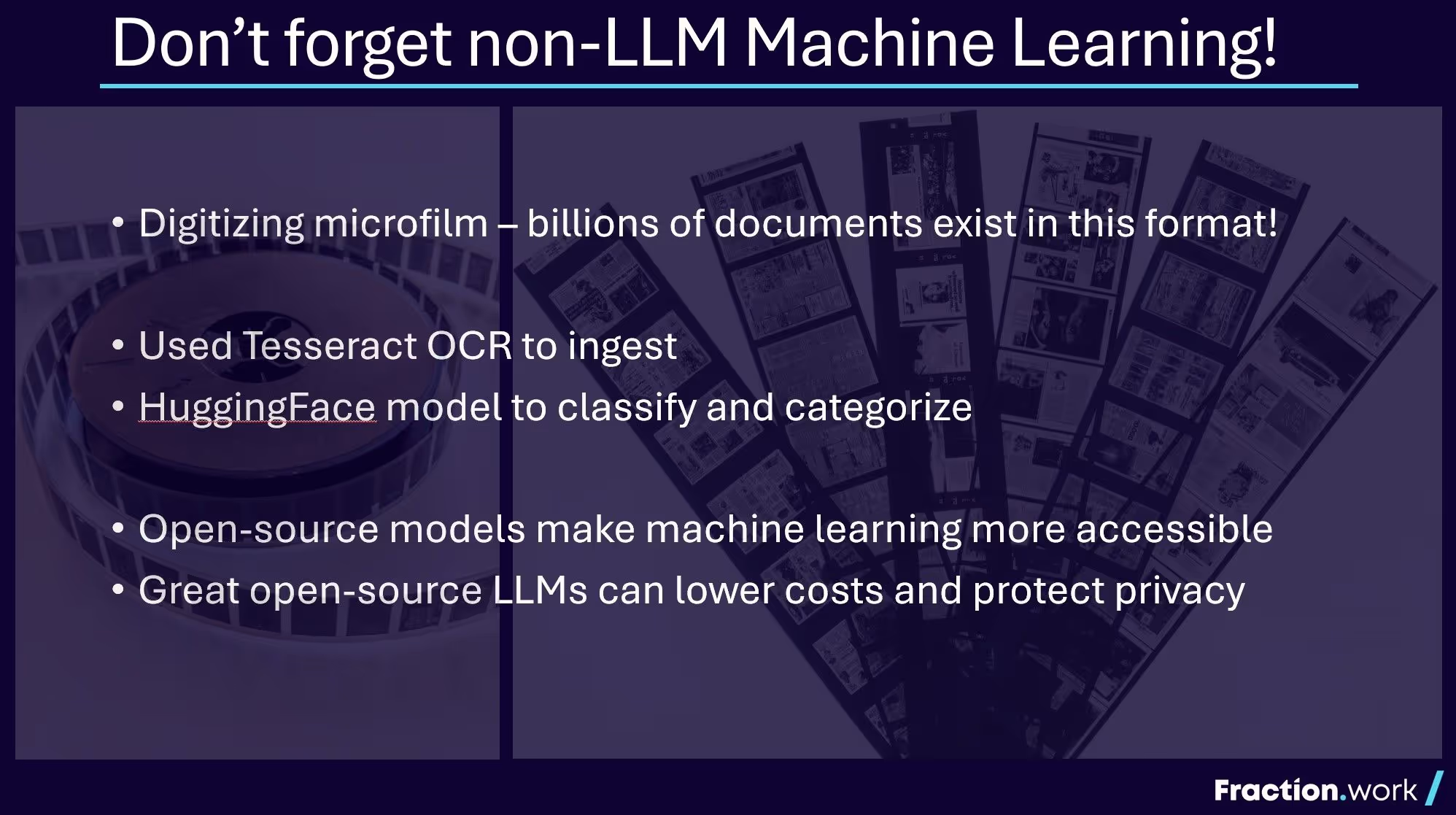
One compelling real-world example involves large-scale microfilm image processing. A team needed to digitize and organize a substantial archive of microfilm documents — historical and legal materials that stored enormous amounts of structured information in image form.
Instead of routing documents through a general LLM, the team deployed purpose-built open-source OCR and classification models in the cloud. The decision was driven by accuracy requirements: the LLM alternative introduced hallucination risk and per-token costs that compounded across thousands of documents. The specialized approach delivered higher fidelity output at a dramatically lower cost.
The experience reinforces a critical point: full stack engineers can spearhead impactful machine learning projects using non-LLM models. The technology is available, the platforms are accessible, and the cost economics strongly favor purpose-built solutions for well-defined tasks.
What are the concrete cost and performance advantages of non-LLM machine learning?
Non-LLM machine learning offers compelling cost advantages for any workload that involves structured tasks at volume. The comparison is not even close for most production use cases.
A specialized OCR or classification model running in the cloud processes thousands of requests per day at a fraction of the API cost of a general-purpose LLM. LLM APIs charge per token; specialized models charge per compute unit, and they use far fewer compute resources per inference. For a team processing 10,000 documents per day, the difference can amount to tens of thousands of dollars annually.
Performance advantages compound the economic case. Purpose-built models are trained on domain-specific data and optimized for their narrow task. An OCR model trained on document images outperforms a generalist LLM on OCR tasks — not because the LLM is bad at reading text, but because the OCR model has no other job. It does one thing and does it with minimal error.
Adopting a strategic focus on non-LLM models also reduces operational complexity. There is no prompt to maintain, no output format to parse, no guardrail layer to prevent hallucinated results. This simplicity improves system reliability and reduces the engineering overhead of keeping the model in production.
How do you build a team that can execute non-LLM ML projects effectively?
The skills needed to ship a non-LLM ML project are closer to standard software engineering than most teams expect. The gap is not as wide as it was five years ago, and the tools available on open-source platforms have narrowed it further.
Investing in targeted training programs pays dividends. Identify the specific gaps — model selection, data preprocessing, deployment infrastructure, evaluation metrics — and address them directly. Online resources, vendor documentation, and HuggingFace’s own tutorials provide practical, hands-on learning paths without requiring a formal ML background.
Workshops and project-based learning are more effective than passive instruction. A team that deploys a real classification model to a staging environment learns more in a week than they would in months of coursework. Combining theoretical instruction with real-world application produces engineers who can execute confidently.
Non-LLM based machine learning refers to the broad set of ML techniques that do not rely on large language models. This includes classical methods like decision trees, random forests, support vector machines, and k-nearest neighbors, as well as specialized neural networks such as convolutional neural networks (CNNs) for image recognition and OCR models for text extraction. These techniques are often more accurate, faster, and cheaper than LLMs for well-defined, structured tasks.
When should you use a traditional ML model instead of an LLM?
Use a traditional ML model when your task is well-defined and involves structured or domain-specific data: classifying images, extracting text from documents, detecting anomalies in time-series data, or predicting a numerical outcome from tabular inputs. LLMs add cost and complexity without adding accuracy in these scenarios. If you can define the input and output types precisely, a purpose-built model almost always outperforms a general-purpose LLM.
What are the cost advantages of non-LLM machine learning?
Purpose-built ML models are significantly cheaper to run at scale than LLMs. A specialized OCR or classification model running in the cloud can process thousands of documents per day at a fraction of the API cost of an LLM. They also require less compute at inference time, produce more predictable outputs, and can be fine-tuned on your specific data without the overhead of prompt engineering.
What is HuggingFace and why does it matter for non-LLM ML?
HuggingFace is an open-source platform that hosts thousands of pre-trained machine learning models — including OCR models, image classifiers, sentiment analyzers, and many other task-specific tools. For full stack engineers, it dramatically lowers the barrier to deploying non-LLM ML: instead of training a model from scratch, you can download a pre-trained model, fine-tune it on your data, and deploy it within days. It has become the primary resource hub for practical, production-ready ML.
Can a full stack engineer deploy non-LLM machine learning without a dedicated ML team?
Yes, for most targeted use cases. Open-source platforms like HuggingFace provide pre-trained models that can be integrated into existing tech stacks without deep ML expertise. Containerization tools like Docker and orchestration platforms like Kubernetes make deployment manageable for engineers already comfortable with cloud infrastructure. The main requirement is clear problem definition — knowing exactly what input goes in and what output you need.
What deployment options exist for non-LLM ML models?
Non-LLM ML models can be deployed in the cloud (AWS, GCP, Azure), on-premises for data-residency requirements, or in hybrid configurations. Cloud deployment using containers (Docker) and orchestration (Kubernetes) is the most common path for teams that need scalability without managing hardware. On-premises is preferred when data cannot leave a controlled environment, such as healthcare or government applications.
Praveen Ghanta
CEO, Hire Fraction
Praveen Ghanta is a five-time founder and serial entrepreneur. He is the founder of DevHawk.ai, an AI-powered engineering management platform, and Fraction.work, which connects fast-growing companies with top fractional tech and growth marketing talent. Previously, he founded HiddenLevers, a risk analytics platform for wealth management that he bootstrapped from inception to acquisition by Orion Advisor Solutions in 2021, serving thousands of advisors and $600B in assets. He earlier founded SmartWorkGroups, acquired by Intralinks in 2000.
Describe your software or AI project. Get a full scope with story-point pricing, sprint estimates, and a downloadable plan in minutes. No calls, no waiting.