Oops! Something went wrong while submitting the form.
By providing a telephone number and submitting this form you are consenting to be contacted by SMS text message. Message & data rates may apply. You can reply STOP to opt-out of further messaging.
Fractional Hiring
Fractional Developer Management to the Rescue
Your dev team isn't underperforming — it's missing the management layer that translates business goals into shipped software.
Praveen Ghanta, CEO, Hire Fraction·June 22, 2023·4 min read
The four distinct management roles — Product Manager, Software Architect, Engineering Manager, and Project Manager — and exactly what each one does that developers cannot do themselves
Why a 2–4 person dev team with a full management layer is upside-down from a cost perspective, and what the alternative looks like
The specific dollar figure ($4,000/month) at which fractional management for a 2-person dev team becomes viable — and how it scales
Why outsourced dev teams fail without a client-side management layer, even when the developers are technically skilled
How to evaluate whether your team needs fractional management vs. a full-time engineering manager hire
You hired a good developer. The product isn’t done. The developer is frustrated. You’re confused. Nobody is wrong — the problem is structural, not individual.
What is the management gap that stalls small dev teams?
Here is a conversation that plays out at hundreds of early-stage companies every year.
The founder asks: “I hired a good developer. So where is my product? Shouldn’t it be done by now? Why don’t the developers get anything done?”
The developer thinks: “Every time I talk to the CEO and the team there’s a new idea. I’m chasing all these different threads and have no idea what this application is actually supposed to do. Every time I get 90% done with something and show it to them, they want to pivot it.”
Both perspectives are legitimate. The founders aren’t irrational for wanting results. The developer isn’t lazy for feeling unmoored. What’s missing is the management layer that translates a CEO’s off-the-cuff ideas into clear, prioritized, buildable requirements — and holds the team accountable to finishing them.
Definition
Fractional developer management: a model in which a company retains part-time product management, software architecture, and engineering management expertise to direct and improve an existing development team — providing the coordination and decision-making infrastructure that most small dev teams lack, without the cost of multiple full-time leadership hires.
What does each management role contribute to a dev team?
Larger product teams solve the coordination problem by splitting it across four distinct roles. Each owns a different dimension of delivery:
Product Owner / Product Manager — owns the What: what are we building, and does it meet the needs of customers and prospects? Without this role, developers build features that are technically complete but commercially irrelevant.
Software Architect — owns the How: what is the technical approach, what is the stack, and does the architecture support the product’s goals? Without this role, teams make costly technical decisions early that become constraints later.
Engineering Manager — owns the Who: who on the team owns each task, who is blocked, and who needs to unblock them? Without this role, work accumulates at bottlenecks and developers sit idle waiting for decisions.
Project Manager / Scrum Master — owns the When: are individual workstreams on schedule, are dependencies identified, and is communication flowing between stakeholders? Without this role, timelines slip invisibly until they become crises.
Each of these roles requires a different skill set. Most developers are trained to execute within one of these dimensions — usually the How — not to orchestrate all four simultaneously. Expecting a developer to self-manage across all four is the structural mistake that causes most early-stage product delays.
Why doesn’t full-time management make sense for a small dev team?
The logical response to the management gap is to hire managers. The problem is that a full complement — product manager, software architect, and engineering manager — costs more than the development team itself on a team of 2–4 engineers.
Role
What they own
Typical full-time cost
Product Manager
What to build and why
$130,000–$180,000/yr
Software Architect
Technical approach and stack decisions
$160,000–$220,000/yr
Engineering Manager
Team execution and unblocking
$150,000–$200,000/yr
Fractional management (all three)
All of the above
$4,000–$8,000/mo
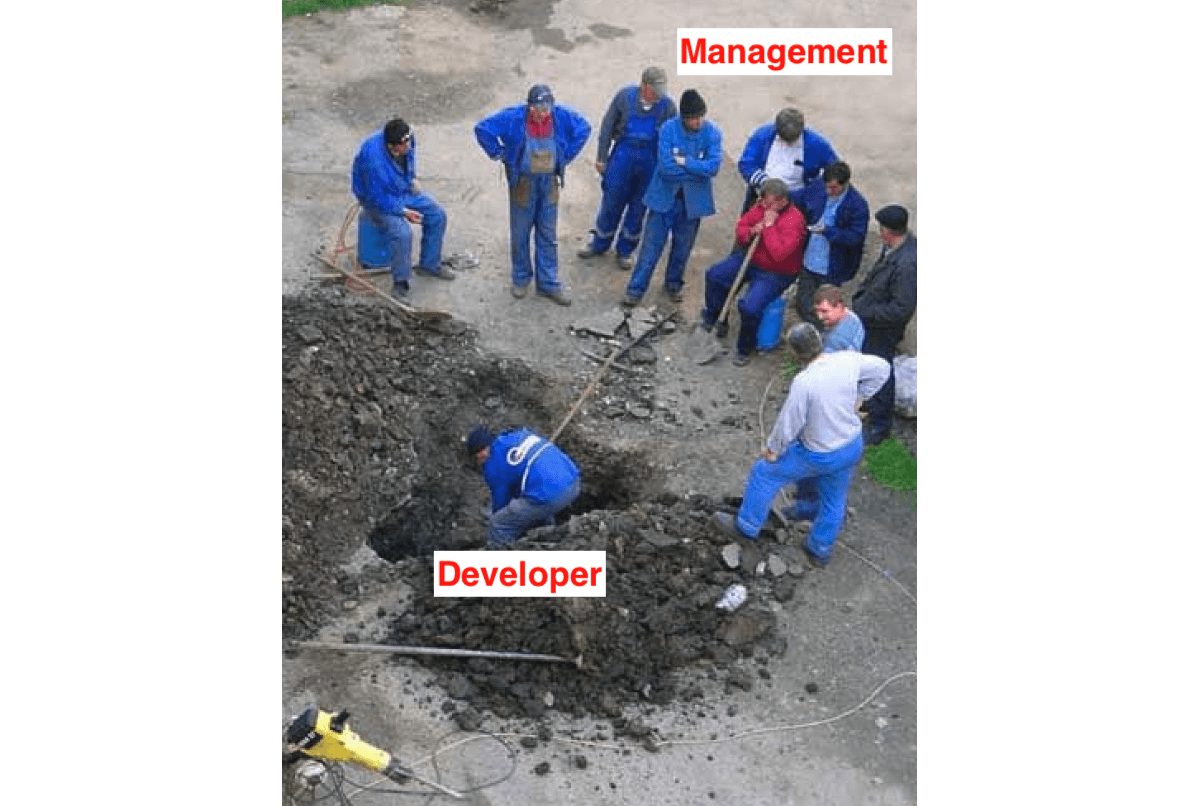
Hiring managers in excess of your developer headcount is one of the classic over-hiring mistakes in tech. At scale, the ratios work. On a 2-person dev team, they produce exactly the caricature every startup jokes about: four managers watching one developer write code.
Want to scope what fractional management would look like for your team?
Get a structured plan for your development project — including sprint estimates and story-point pricing. Free and instant, no call required.
How does fractional management actually work in practice?
Fractional management applies the same part-time engagement model that works for fractional-to-full-time hiring to the management layer specifically. Instead of hiring three full-time managers, you retain a fractional team that provides product ownership, software architecture guidance, and engineering management — typically 10–20 hours per week combined — at a monthly rate that a 2–4 person dev team can afford.
Fraction’s Manage plan is priced at $4,000 per month for a 2-person dev team. It scales at $2,000 per month for each additional developer. At that level, the engagement covers both project management and software architecture guidance: the fractional team translates business goals into developer requirements, makes hard technical calls, and acts as the connective tissue that turns a capable but undirected dev team into one that ships.
The CEO also stays directly involved. Any client on the Manage plan — or working with two or more Fraction resources — gets direct access to leadership on their Slack, bringing the same operational and profitability instincts that built HiddenLevers from zero to a 52% pre-tax margin before its acquisition by Orion.
For teams evaluating whether fractional management is the right fit, the key question is not “can we afford this?” but “what is the cost of not having it?” A dev team without the management layer doesn’t just ship slowly — it often ships the wrong things efficiently, which is more expensive than shipping nothing.
How does fractional management apply to outsourced developer teams?
The management gap is most acute — and most costly — when the development team is outsourced. Outsourced developers typically have no management layer on the client side at all. The client sends requirements (often informally), the developers execute, and the result rarely matches what the client actually needed.
This is not a developer quality problem. Most experienced outsourced development teams are technically skilled. The problem is that translating a CEO’s strategic intent into buildable, prioritized requirements requires industry vertical knowledge and product judgment that most developers — outsourced or in-house — were not hired to supply.
Fraction’s Manage plan was originally designed to solve exactly this problem. Clients began requesting help managing their existing outsourced teams, and the fractional approach proved effective enough to formalize into a dedicated offering. The fractional team acts as the client-side management layer that outsourced development almost always needs but rarely gets — providing the onboarding structure and ongoing guidance that keeps outsourced developers aligned with business goals.
Frequently asked questions
What is fractional developer management?
Fractional developer management means hiring part-time product management, software architecture, and engineering management to oversee and improve an existing development team — without the cost of hiring full-time managers. A fractional manager typically works 10–20 hours per week embedded in your team, filling the gaps that cause most small dev teams to stall: unclear requirements, poor technical decisions, and lack of accountability.
Why does a small dev team need a product manager and engineering manager?
Without clear product ownership, developers chase shifting requirements and never finish anything. Without an engineering manager, no one unblocks the team, makes hard technical decisions, or holds engineers accountable to timelines. And without a software architect, the team may build something technically unsound that costs far more to fix later. These roles aren’t redundant overhead — they are the infrastructure that makes developers productive.
How much does Fraction's fractional developer management plan cost?
Fraction’s Manage plan starts at $4,000 per month for a 2-person dev team and scales at $2,000 per month per additional developer. The plan includes both project management and software architecture guidance. This is significantly less than the combined cost of a full-time product manager, engineering manager, and software architect — which would typically run $400,000 or more per year in total compensation.
What is the difference between a product manager and an engineering manager?
A product manager owns the What — deciding what to build and ensuring it meets customer and business needs. An engineering manager owns the Who — assigning work across the team, unblocking developers, and keeping the project on track. A software architect handles the How — choosing the tech stack, making key technical decisions, and ensuring the architecture can meet the product’s goals. All three roles are distinct but interdependent.
Can fractional management work for an outsourced development team?
Yes. Fractional management is especially well-suited for outsourced teams, which typically lack any internal management layer on the client side. Without product and engineering management from the client, outsourced developers often build the wrong things efficiently — producing technically correct work that doesn’t meet actual business requirements. A fractional manager bridges that gap, translating business goals into clear developer requirements and holding the outsourced team accountable to delivery.
When should a startup hire a fractional developer manager vs. a full-time engineering manager?
Hire fractional when your development team has fewer than five engineers and you do not yet have enough ongoing management work to justify a $180,000–$220,000 full-time hire. Transition to full-time when management demand is consistent across 40+ hours per week, when you need someone deeply embedded in your culture making daily decisions, or when the fractional model is creating coordination friction that slows the team more than it helps.
Praveen Ghanta
CEO, Hire Fraction
Praveen Ghanta is a five-time founder and serial entrepreneur. He is the founder of DevHawk.ai, an AI-powered engineering management platform, and Fraction.work, which connects fast-growing companies with top fractional tech and growth marketing talent. Previously, he founded HiddenLevers, a risk analytics platform for wealth management that he bootstrapped from inception to acquisition by Orion Advisor Solutions in 2021, serving thousands of advisors and $600B in assets. He earlier founded SmartWorkGroups, acquired by Intralinks in 2000.
Describe your software or AI project. Get a full scope with story-point pricing, sprint estimates, and a downloadable plan in minutes. No calls, no waiting.